
Tmux vs Zellij for AI Coding Agents
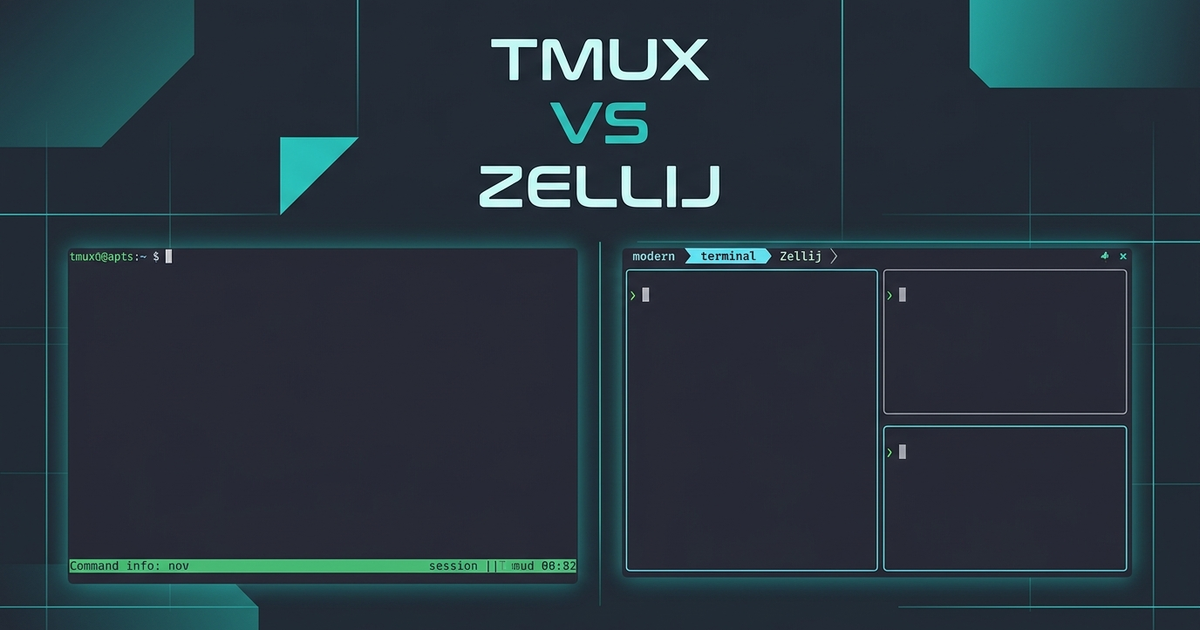
Tmux vs Zellij for AI Coding Agents. Both multiplexers keep coding agents running when you close the laptop lid; the real difference is how much configuration each one demands before a fleet of parallel agents is comfortable to operate. Tmux wins on ubiquity and script surface, Zellij wins on sane defaults and low-friction plugins — and Ferryx sits outside this argument entirely, owning sessions in a daemon rather than a multiplexer server, which is worth keeping in view while you choose.
Where tmux still wins for agent fleets
Longevity is not a small thing. tmux has shipped since 2007, every SSH’d server on earth already has it, and every agent-adjacent trick ever written assumes it: tmux new-session -d in a deploy script, send-keys driving a pane, control-mode clients for programmatic attach. If your fleet orchestration is a shell script — start five panes, name them, pipe commands — tmux’s CLI is the most documented automation surface in the terminal world.
Configuration depth is the second advantage. Agents produce output patterns that stock rendering sometimes mangles — heavy scrollback from a chatty loop, rapid redraws during test runs, unicode box-drawing from TUI frameworks. tmux’s option surface (escape-time, aggressive-resize, alternate-screen handling, copy-mode history limits) lets you chase each quirk individually. When a specific tool misbehaves inside tmux, there is almost always a set -g somewhere in the archives that fixes it.
Third: the server model is well understood operationally. One tmux server process per user, sessions attachable from anywhere, kill-server as a clean reset. Operations teams with decades of muscle memory are not a feature of the software, but they are a feature of choosing it.
Where Zellij defaults help agents
Zellij’s pitch is that a fresh install behaves like a tool designed this decade. Pane frames come with visible names, a session picker exists out of the box, and the default keybindings avoid the C-b prefix ceremony. For an operator watching six agent panes, the always-visible tab bar with per-pane status is the difference between glancing and interrogating.
Plugin loading matters more for agents than for interactive use. Zellij’s plugin system runs WebAssembly modules that can render status and react to events without a shell-out — where tmux plugins are shell scripts polling capture-pane. For a fleet status strip (which agent finished, which is prompting), Zellij’s path is architecturally closer to a real event surface, even though the ecosystem around it is younger.
The configuration you don’t write is the third win. Zellij ships sensible pane detachment behavior, sane scrollback defaults, and a permission prompt system for plugins that can bind keys. A team adopting it for agents starts from a working layout instead of reconstructing one from dotfile archaeology.
Where both hit the same wall
Neither multiplexer fixes the two structural gaps for agent fleets. Isolation: both run every session against one shared server environment — one SSH_AUTH_SOCK, one working directory convention, one set of env exports. Two agents sharing a checkout will still race on .git/index.lock regardless of which multiplexer displays them. Recovery: tmux-resurrect and Zellij’s session persistence restore panes and commands, not task narrative — which agent was mid-refactor and which already finished needs external bookkeeping.
Status depth is the third shared ceiling. Pane titles and plugin-rendered bars report what a shell is doing, not what an agent wants: permission prompts, task completion, tool-call stalls. Getting that out of either tool means the agent emits machine-readable state somewhere a plugin can read — extra plumbing in both.
Decision matrix by workflow
| Your situation | Better fit | Why |
|---|---|---|
| Fleet runs on shared servers you do not control | tmux | Preinstalled everywhere; zero-install adoption |
Orchestration is existing shell scripts (send-keys, control mode) | tmux | Deepest programmatic surface; scripts already written |
| Fresh setup, small team, values visible defaults | Zellij | Works without config archaeology |
| Status strip via in-process plugins | Zellij | WASM plugins render state without shell polling |
| Agents span heterogeneous machines | Neither | Need a daemon/client split: this is Ferryx’s shape |
| Isolation per agent is non-negotiable | Neither | Needs worktree-per-agent, not a better multiplexer |
Read the last two rows carefully: if your answer lands there, you are not choosing a multiplexer — you are describing a workspace manager. Ferryx vs Zellij covers that comparison directly, and migrating from tmux walks the move from either tool once the scripts start outnumbering the agents.
A two-week trial that settles it
- Run one real workstream in each tool for a week — same kind of task, not toy repls.
- Count alt-tabs per day. The tool needing fewer is surfacing status; the one needing more is hiding it.
- Deliberately drop the network once per week and reattach. Note what state you reconstruct from memory.
- Write down the first script you had to build in each. That script is the feature gap you will maintain forever.
FAQ
Does Zellij run existing tmux config files?
No. Zellij has its own config format and deliberately different defaults; migration means re-expressing binds and options rather than copying ~/.tmux.conf. Layout concepts map roughly (windows, panes, sessions), but scripts calling tmux CLI commands need rewriting against Zellij’s CLI and plugin interfaces.
Which one handles heavy agent scrollback better?
Both buffer large scrollback reliably with history limits raised; neither rewrites the rendering pipeline. The felt difference is in redrawing: tmux’s maturity means documented fixes for specific TUI redraw quirks, while Zellij’s newer renderer handles common cases well but has thinner archives when an odd tool glitches. Whichever you pick, keep a per-tool escape hatch (alternate-screen settings) ready.
Can either show when an agent is waiting for permission?
Not natively — pane state reflects the shell, and an agent’s prompt request is application-level state. With effort: a Zellij plugin can watch a marker file your agent writes; tmux needs a polling script updating the pane title. Both are approximations. A tool reading agent events directly (agent status badges in Ferryx) answers it structurally instead of heuristically.
Will I lose my tmux muscle memory switching to Zellij?
Mostly preserved: prefix-based navigation, pane splitting, and session attach all have Zellij analogs, and optional emulation modes soften the jump. The friction concentrates in scripting — muscle memory for interactive use transfers faster than muscle memory for automation.