
Parallel Agents and Database Collisions
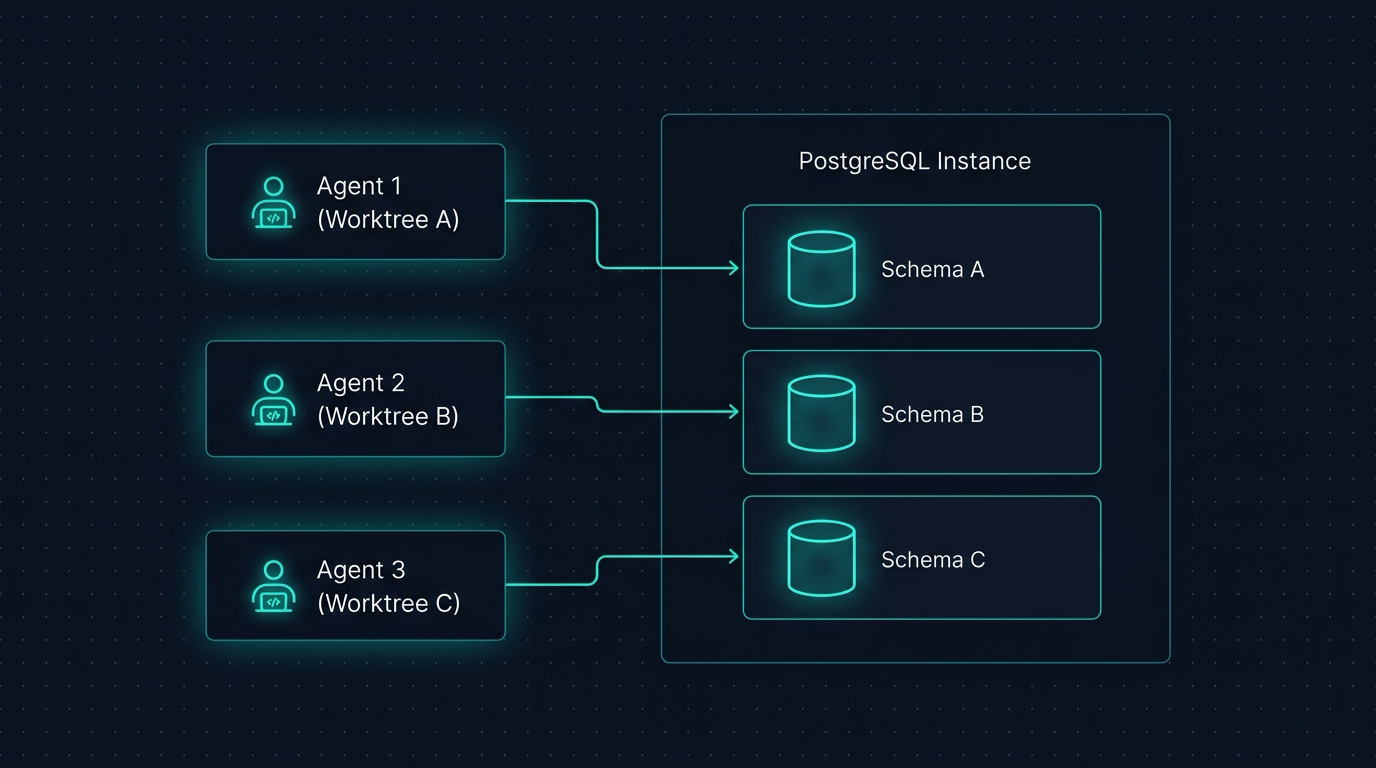
Parallel Agents and Database Collisions. Parallel agents sharing one dev database collide at three levels — migrations stepping on each other’s schema history, seed/fixture runs overwriting shared tables, and two transactions writing the same rows with last-writer-wins semantics — and the durable fix is database-per-worktree: give every agent its own schema, database, or container, provisioned automatically from the worktree’s lifecycle and advertised through its environment, so isolation is a property of the checkout rather than a rule everyone remembers — the same lifecycle Ferryx uses to bind each session to its managed worktree.
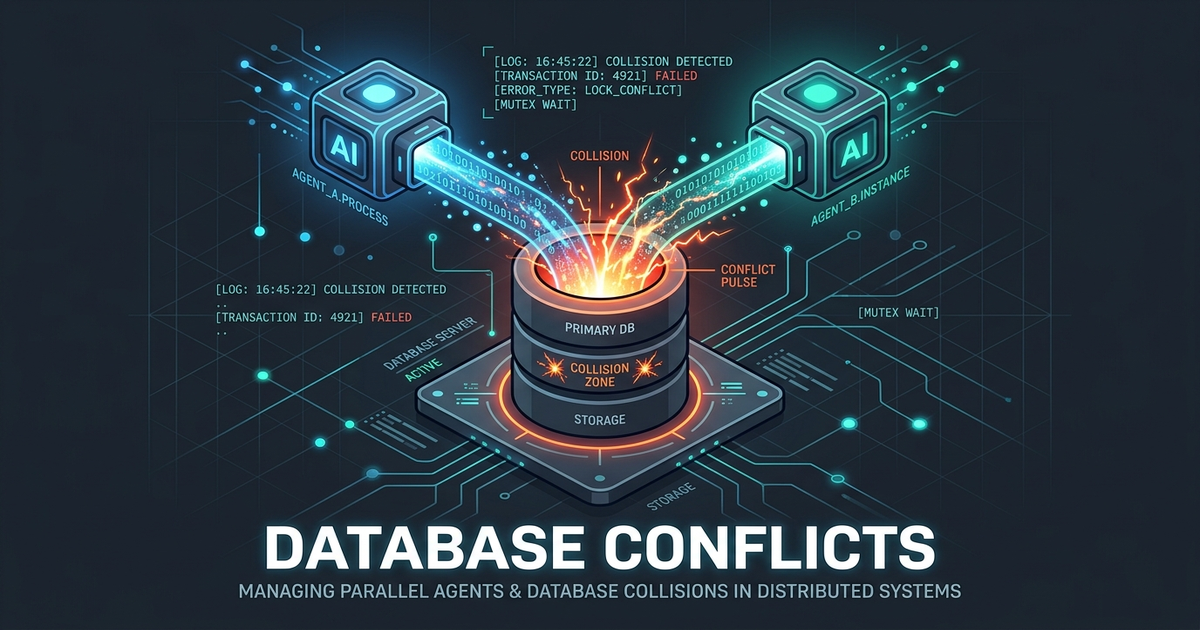
Shared database failure modes
Agents hit the shared database harder than humans do because they reset more often. Three recurring failures, in the order they usually appear:
Migration races. Agent A runs migrate adding column x; agent B, in its own branch, runs a different migration adding column y — both against the same schema history table. Depending on your migration tool’s locking, you get either a failed migration (loud, annoying) or two partially-applied heads (quiet, dangerous: each agent’s green tests ran against a schema neither branch actually describes). Branch-shaped migrations assume branch-shaped databases; one shared schema violates the assumption structurally.
Seed and fixture stomping. Test suites and demo-data scripts typically truncate + insert — correct against their database, destructive against a shared one. Agent A’s test run wipes rows agent B’s server was serving, and B’s symptoms (500s, empty lists) have no local cause: the cause lives in another worktree’s test command. These bugs are famously hard to attribute because every tree’s code is innocent.
Write contention at the row level. Two agents exercising the same entity — same user, same cart, same job row — interleave transactions. Lost updates, unique-constraint violations that only reproduce under concurrency, and dirty reads make both agents’ observations unreliable: each is debugging against a database the other is mutating underneath them.
The common structure: shared mutable state without per-actor fencing. Worktrees isolate files and git state perfectly; the database is the one shared resource most setups forget to fence along the same boundary — which is why database collisions are the second fight (after git locks) every parallel fleet discovers.
Schema or container isolation
Two isolation granularities, both correct; pick by tooling weight:
Schema-per-worktree (lightweight). One physical server, one namespace per worktree: app_wt_authfix, app_wt_pagination. Provisioning is one CREATE SCHEMA (or CREATE DATABASE) plus env pointing the app at it; cost is near zero; cleanup drops the namespace. Works when your stack respects schema boundaries cleanly (Postgres schemas, MySQL databases) and migrations are schema-scoped. The failure mode to verify: tools that hardcode the public schema or cross-schema search paths — test one real migration round-trip before committing the team.
Container-per-worktree (heavyweight, hermetic). Each worktree’s compose file brings up its own Postgres/Redis/whatever on its own ports, volume scoped to the tree. Full version pinning per branch (agent A runs Postgres 14 for the legacy migration; agent B runs 16), complete teardown with docker compose down -v, and zero cross-talk by construction. The costs: disk and RAM multiply by concurrent trees, first-boot migrations add latency, and port partitioning (the ports problem) reappears for the database’s own port — solve it with the same derivation scheme.
The hybrid most fleets land on: one long-lived scratch server with schema-per-worktree for everyday iteration (fast, cheap), plus container isolation reserved for branches that must pin engine versions or run destructive tooling (upgrades, down migrations). The deciding question per worktree: does this branch need a different database than the trunk? If yes, container; if no, schema.
Wiring env vars per worktree
Isolation exists only if every process in the worktree reads the right connection string — the wiring step is where fleets leak:
- Derive the connection string from worktree identity. Host, port, and database name all keyed off the slot/slug (
DATABASE_URL=postgres://localhost:5433/app_wt_<slug>), the same derivation used for app ports — one scheme, two consumers. - Write it where the app actually reads it. Per-worktree
.env(never committed — the.env.exampledocuments the keys, the worktree’s ignored.envholds values) or exported vars in the session’s shell profile. Agents launchingnpm run devinherit it without knowing it is special. - Assert identity at startup. The app (or a preflight check) prints the database name/banner on boot — a one-line “connected to
app_wt_authfix” makes a mis-wired tree obvious in the first second, before tests assert against the wrong data. - Provision from the worktree lifecycle, not from a wiki page. If creating a tree requires a human to follow setup docs, agents will skip it. Tying provisioning (run the schema create, write the env file) to worktree/session creation is what makes isolation the default path — the pattern a workspace manager can own, and what Ferryx’s managed-worktree lifecycle hooks are shaped to carry.
- Teardown with the tree. Dropped schemas and removed volumes on worktree removal keep disk honest and prevent yesterday’s
app_wt_tmpfrom becoming tomorrow’s mystery leak.
The payoff is attribution: when an agent’s tests fail, the database is its database, so the bug is in its branch — the property worktrees already gave you for files, extended across the last shared resource. Repo-level isolation mechanics are covered in the same-repo two-agent pattern, and the fleet view of which run owns which resources is the cross-provider fleet inventory.
FAQ
Isn’t a database per worktree overkill for quick tasks?
For one-off branches that never touch data paths, yes — skip it. The trigger for spinning one up should be the agent running tests or servers that touch the DB, not the mere existence of a worktree. The cheap default is the scratch schema (near-zero cost), reserving container isolation for branches that need version pinning — so “overkill” is opt-in by branch requirement, not the baseline.
How do migrations work if each worktree has its own database?
Each worktree runs its own migrations against its own schema on its own schedule — which is precisely the point: branch A’s half-finished migration cannot corrupt branch B’s history. Merge-time migrations get resolved the same way code conflicts do (one branch’s migration wins, the other rebases), so the shared trunk’s database always receives a linear sequence even though branches developed in parallel.
What about Redis, RabbitMQ, and other stateful services?
Same fence, same patterns: Redis trivially (logical DB indexes or container-per-tree), brokers less so (virtual hosts or per-tree containers with partitioned ports). The decision rule is unchanged — shared mutable state gets a per-actor namespace — and the services that cannot namespace cleanly are the ones deserving container isolation by default.
Can Ferryx provision database isolation automatically when I open a worktree?
The lifecycle hook is exactly where it belongs: worktree/session creation already runs provisioning steps (the managed worktree model creates directory, branch, and env), and adding schema creation + env wiring extends the same step — no schema-aware feature is required, just provisioning tied to tree birth. The fleet registry then records which namespace each session owns, for teardown on removal.