
Mosh vs Outbound-Relay Remote Terminals
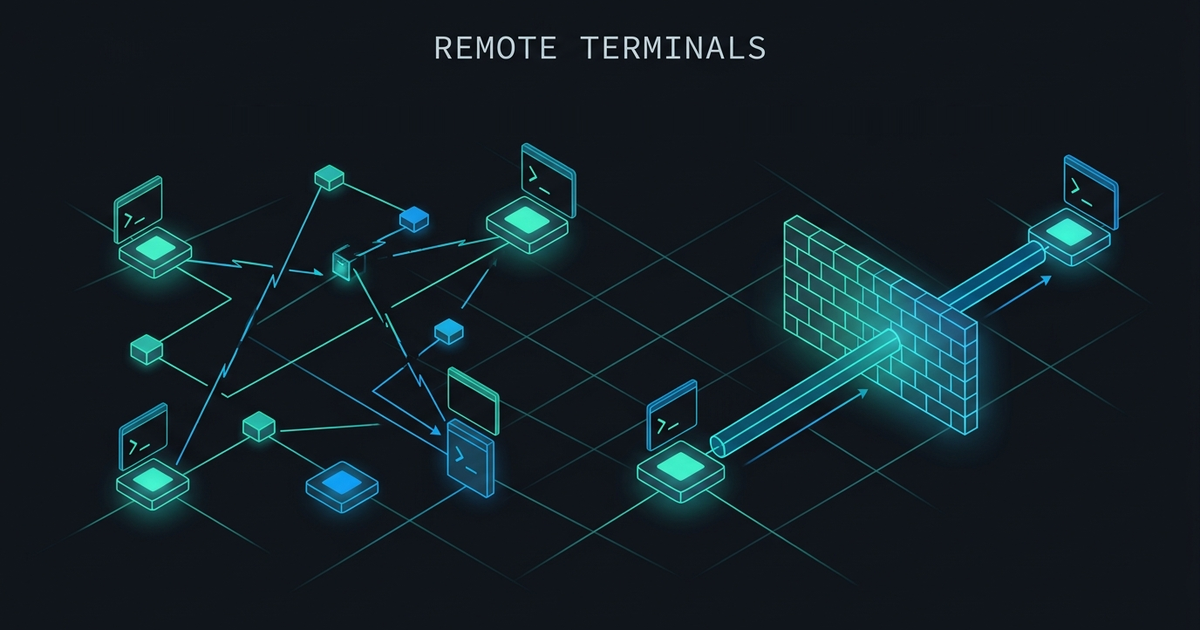
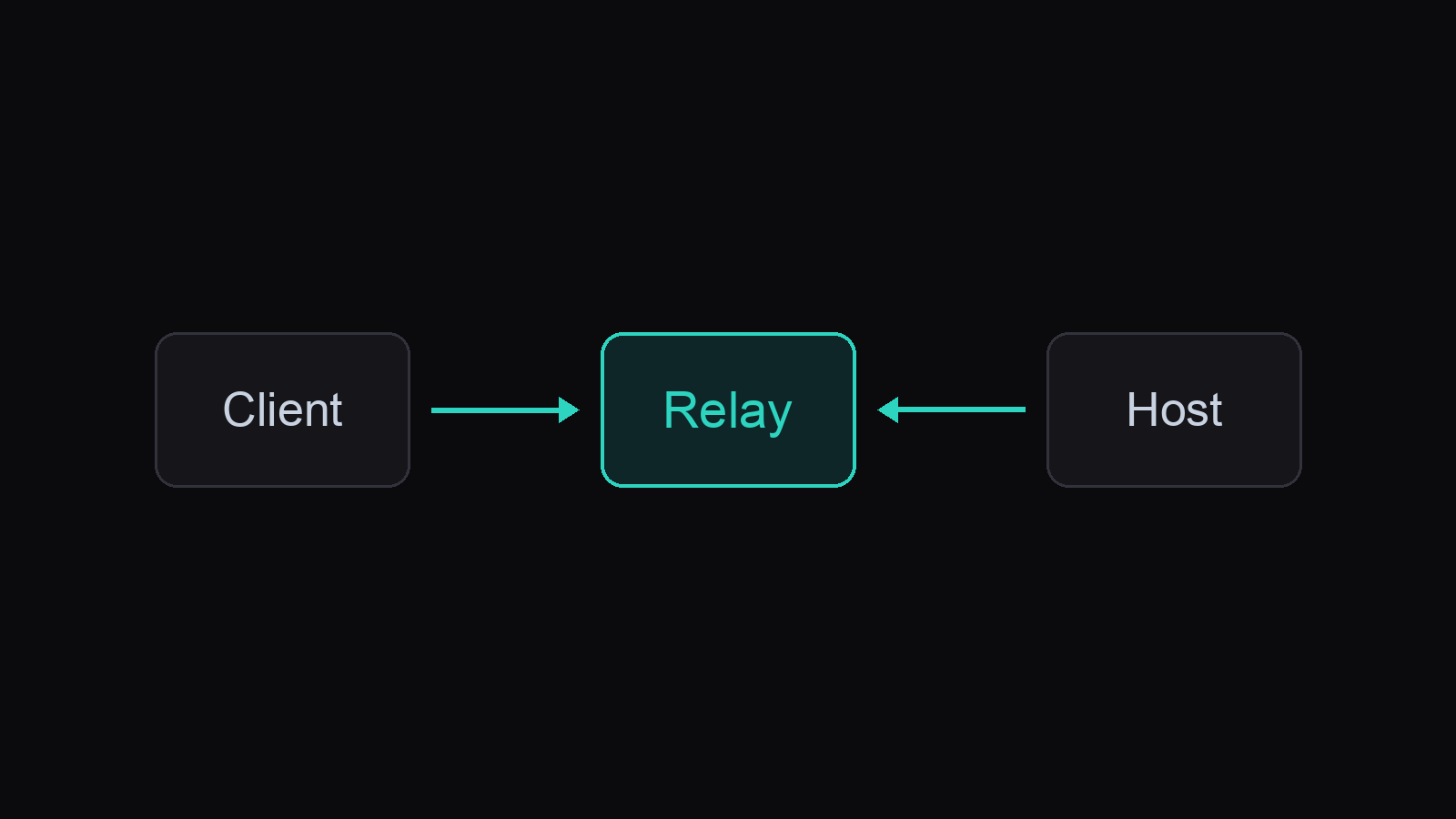
Mosh vs Outbound-Relay Remote Terminals. These solve different layers of the same reachability problem: Mosh replaces SSH’s TCP session with a UDP state-sync protocol so a session roams across network changes — but still requires you to reach the host directly, UDP ports included. An outbound relay inverts the dial direction: your dev machine dials out to a relay, clients dial the same relay, and nothing on the host is ever inbound-addressable — so NAT, firewalls, and hotel networks stop being obstacles by construction, the dial direction Ferryx’s paired remote also relies on. They compose as often as they compete: relay for reachability, Mosh-like transport for roaming once a path exists.
Transport differences
Mosh is a protocol-level replacement for SSH’s stream. The client and mosh-server sync terminal state (screen contents) over encrypted UDP; lost packets repair via the next sync, IP changes re-key the session to the new address, and a prediction layer keeps typing feel local. What it preserves from SSH: you still initiate against a specific host address on a specific port — the standard reachability contract. What it changes: the session tolerates transport churn instead of dying with it.
An outbound relay is a topology-level change. The dev machine runs a client that maintains a persistent outbound connection to a relay (self-hosted on a VPS, or a hosted service); the browser/phone/client also connects to the relay; the relay splices the two streams together. There is no listening port on the dev machine at all — no forwarded port, no exposed sshd, no UDP hole to punch. The relay sees a splice (or, in privacy-preserving designs, ciphertext it cannot parse); the host’s attack surface from the network is zero inbound, because no inbound exists.
The layer distinction is the whole comparison: Mosh changes what happens to bytes on a path you already have; the relay changes whether you have a path at all. Evaluating either against the wrong question produces confident wrong answers — “Mosh doesn’t help, my host has no open ports” (true, and beside the point: the relay question) and “the relay doesn’t help, my sessions keep dropping” (true for drops after connection, which is Mosh’s question).
One composition note: relays typically carry TCP streams, so plain SSH rides them natively — and SSH-over-relay already survives drops if sessions below it are owned (tmux/daemon), because the reattach is cheap. Roaming-without-reattach (Mosh’s signature move) requires the relay or its transport to support connection migration, which is a per-relay capability question — verify rather than assume.
NAT and firewall behavior
| Scenario | Mosh alone | Outbound relay |
|---|---|---|
| Home NAT, no port forwarding | Fails — needs inbound UDP port + forwarding | Works — host dials out only |
| Corporate firewall, UDP blocked | Fails — Mosh cannot start | Works — single outbound TCP/WebSocket |
| CGNAT (no public IP at all) | Fails — nothing to address | Works — no address needed |
| Client on hostile/roaming network | Strong — session follows IP changes | Depends — stream may drop; reattach cheap if sessions owned |
| Host behind policy: “no inbound ever” | Violates policy | Compliant by construction |
The pattern in the table: Mosh fails the first-mile tests (everything requiring inbound reachability) and wins the last-mile test (client-side roaming). The relay inverts it — trivially passes first-mile (it only dials out), while last-mile smoothness depends on what transport runs inside the splice and whether your session layer absorbs reconnections. Teams in CGNAT apartments, locked-down offices, or compliance environments reach for the relay first; teams whose hosts are already reachable but roam between networks reach for Mosh first.
Ports and protocol allowances matter operationally: Mosh needs UDP allowed both directions plus mosh-server installed on the host; the relay needs only outbound 443-compatible connectivity — a property that also makes it survive captive-portal environments that redirect everything else.
Security surface of each
Mosh’s surface is conventional and well-audited: SSH authenticates the session (key exchange over the initial SSH channel), then Mosh’s UDP carries the encrypted state-sync with its own key. Your exposure = an open UDP port on the host (scanned, rate-limited by nature of UDP) plus standard SSH-daemon hygiene on port 22. Single-hop, peer-to-peer, no third party in the path — the trust list is short and yours.
The relay’s surface splits by design: (1) reachability trust — the relay is in the connection path; in a naive splice design it can see plaintext, so either end-to-end encryption inside the tunnel (relay sees ciphertext only) or a relay you self-host on your own VPS; (2) authentication — pairing flows (device grants, revocable) rather than host credentials, which is actually a strength over raw SSH: a stolen phone gets its pairing revoked instead of requiring key rotation across machines; (3) blast radius — because the host has zero inbound listeners, scanning, brute-forcing, and unpatched-daemon-CVEs simply do not apply to it. The relay becomes the internet-facing component — which is exactly why self-hosting or E2E-encrypting it is the responsible configuration.
The honest summary: Mosh keeps third parties out but keeps an inbound port in; the relay removes the inbound port but introduces a path component you must trust or own. Which risk you prefer depends on environment — home-lab self-hosters often prefer owning the relay; laptop-roamers on already-reachable hosts often prefer Mosh’s directness. The self-hosted relay post works the relay configuration side, and remote vs SSH frames the adjacent comparison for full remote stacks.
FAQ
Does Mosh work through a relay?
Only if the relay splices a TCP stream Mosh can ride — but Mosh’s UDP transport then needs the relay to forward UDP too, which most TCP/WebSocket relays do not. In practice: SSH-over-relay is the common composition, and if sessions underneath are daemon/tmux-owned, reattach-on-drop approximates Mosh’s survivability without needing UDP anywhere. Verify your relay’s protocol support before assuming otherwise.
Which is better for a machine behind CGNAT with no public IP?
The outbound relay — categorically. CGNAT means no inbound path exists at any layer (no port forward, no UPnP, no DDNS trick), which eliminates Mosh and every direct-SSH variant outright. The relay’s dial-out design needs no address at all: your host connects to the relay, your client connects to the relay, the splice happens there. This is the single environment where the topology choice decides everything.
Can I get Mosh-style network roaming through an SSH relay setup?
Roaming is a property of the transport inside the tunnel: SSH-over-relay reconnects when the stream breaks (cheap if sessions are owned below), but does not seamlessly migrate a live connection the way Mosh’s UDP state-sync does. Some relay/transport implementations add their own migration (QUIC-based transports do); check whether yours does. Alternatively, once the relay makes the host reachable, Mosh itself can ride the path if UDP passes — composition restores roaming where policy allows it.
Is a hosted relay a third party reading my terminal?
Only if you configure it that way — the design axis to check is end-to-end encryption inside the tunnel versus terminated-at-relay transport. E2E designs (relay splices ciphertext) leave the relay operator with metadata only; plaintext-splicing designs require trusting the operator, which is why self-hosting the relay on a VPS you control is the standard recommendation for the plaintext case. The relay architecture post details both configurations.