
Writing Docs in Parallel With Agents
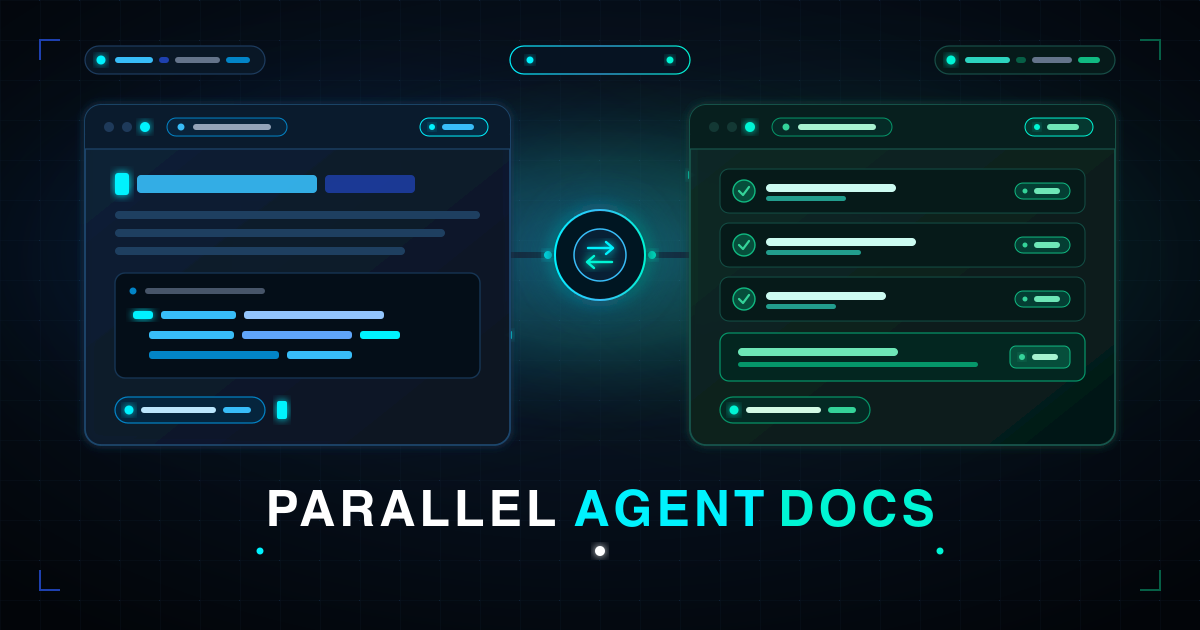
Writing Docs in Parallel With Agents. One agent drafts, one verifies claims against code, in separate worktrees. Claims map to Ferryx docs and cited sources only.
Draft versus verify
Tools do not create workflows by themselves. The teams getting value from parallel agents write down the loop: how specs are written, how review happens, how releases are watched, and how attention is routed so nobody polls ten panes by hand. In the specific case of “Writing Docs in Parallel With Agents”, the Ferryx angle is straightforward: one agent drafts, one verifies claims against code, in separate worktrees. claims map to ferryx docs and cited sources only. Teams evaluating this often arrive from a shared-checkout pain story or from tooling that treats the terminal as a disposable window. Ferryx takes the opposite stance—sessions are daemon-owned, isolation is a first-class action, and everything you need to verify sits behind documented surfaces.
Fact checking
Ferryx workspaces group tabs, panes, and sessions around a project; panes split vertically and horizontally; browser tabs sit beside terminals; the Dock attention counter and agent status badges surface who needs you. Applied to “documentation agents parallel”, that context matters because the failure modes people search for are almost always failures of ownership or visibility rather than of raw rendering. When the process outlives the window, when the buffer can prove what it missed, and when each agent’s files live in a jailed worktree, the same task that used to require three clones and a spreadsheet becomes a pane layout you can read at a glance.
Practical steps
- Name the ritual (release day, incident response, review loop) and the artifacts it produces.
- Assign a pane/browser-tab layout that keeps the critical signal visible without switching context.
- Use worktree isolation so each parallel attempt can be discarded without collateral damage.
- Route attention through status badges and Dock counts instead of manual polling.
- Retire the ritual parts that did not help after one week; keep the rest documented in the workspace.
| Checkpoint | What good looks like |
|---|---|
| Isolation | Each parallel actor has its own worktree or a documented reason not to |
| Visibility | Status badges or attention counters answer “who needs me?” without polling |
| Persistence | Closing the window does not end agent processes |
| Evidence | Claims map to product facts or a linked source |
How this fits Ferryx today
Ferryx ships calendar-versioned releases for macOS (universal DMG), Windows (x64 installer), and Linux (AppImage and .deb). The desktop shell, daemon, and optional ferryx-cli headless binary are described with sources on the product facts page. If you are new to the workspace model, start with the introduction; if you want the mechanical details of sessions and replay, read technical architecture.
Related reading:
FAQ
Do I need agents to use these workflows?
No. The layouts and isolation habits work for ordinary shells, builds, and reviews too; agents simply raise the parallelism.
How do I avoid notification fatigue?
Prefer attention counters and status badges that collapse many signals into one honest indicator over per-event pings.
Where should the team write the ritual down?
In the workspace docs or PR template so a new teammate can run the same loop on day one.
Limits and non-goals
Ferryx is early software: core flows work, but expect rough edges and breaking changes between calendar-versioned releases. Some OS integrations remain platform-specific (Dock badge counters and launchd supervision are macOS-only today), Windows builds are not code-signed yet so SmartScreen warns on first run, and remote features assume you control the host and pairing grants. None of that changes the core claim of this post—daemon-owned sessions, managed worktrees, and visible multi-agent workflows—but it is the honest boundary of what has shipped. Verify anything version-sensitive against the facts page and the release notes before you standardise a team workflow on it. If something in this guide disagrees with your build, trust the repository sources linked from product facts and open an issue with your version string attached.
How to verify these claims
Every concrete statement in this post ties back to a checkable surface: package names and license terms live on product facts, session and buffer behaviour is described in technical architecture, and keyboard bindings are listed under shortcuts. Where a third-party tool is mentioned, treat vendor docs as authoritative for that tool and re-check dates before quoting them in a decision document. That discipline is why this site does not publish performance benchmarks it has not measured: reproducible architecture facts age better than marketing numbers.
Further reading in this workspace
Open the comparison hub if you are still choosing tools, the use cases if you want workflow narrative, or privacy if you are checking what telemetry exists before rolling Ferryx out on a team machine. Each page is maintained with the same verification habit: claims map to sources, dates are explicit, and unmeasured numbers stay out of the text.