
Send Keystrokes to a Terminal Pane Programmatically
Send Keystrokes to a Terminal Pane Programmatically. The reliable ways to inject input into a specific terminal pane are tmux’s send-keys (target a pane by session/window/pane address and write bytes to its PTY), tmux control mode (a structured client/server protocol over which scripts receive events and send commands), and daemon-style session APIs such as Ferryx’s Unix domain socket protocol (address sessions as objects over a socket instead of addressing panes in a grid). Which one you should build on depends on how the pane is identified, how input and output are synchronized, and whether the driving program is a shell script or a long-lived agent.
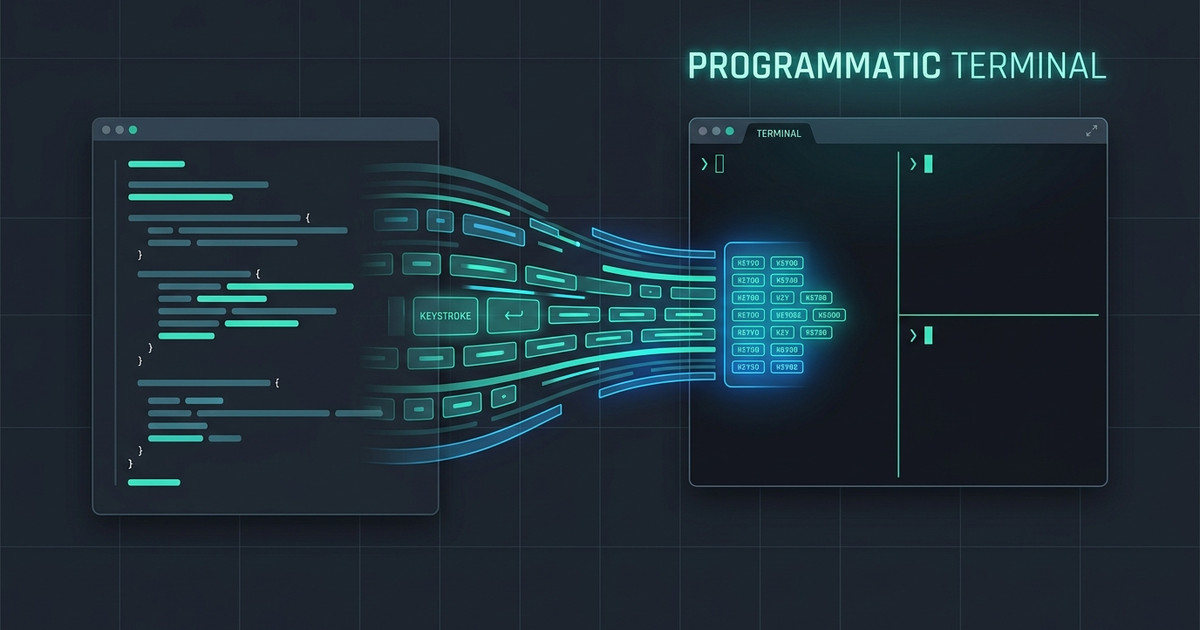
Control channels compared
tmux send-keys is the blunt instrument, and for good reason: it is immediate and needs no daemon design. You name a target (-t session:window.pane), pass literal keys or key names (Enter, C-c, Escape), and tmux writes them to that pane’s PTY as if a human typed. Scripts use it to drive tests in one pane while watching another, or to wake an agent with a confirmation it expects.
Its limits are the limits of pretending to be a human. There is no acknowledgement that the target processed the input — only that tmux handed bytes to the PTY. Timing becomes guesswork: insert a sleep after send-keys and you have encoded a race you will lose under load. Special keys and bracketed-paste sequences must be spelled correctly or an agent’s editor-mode TUI receives garbage. And identity is positional — if the grid re-splits, your saved 2.1 address now points at a different program.
tmux control mode (tmux -C attach) upgrades the relationship. Instead of poking panes by address, the controller speaks a line protocol: tmux pushes structured events (pane output, layout changes, session lifecycle) to every control client, and the client submits commands back — including send-keys targets resolved against live state. This is how terminal multiplexer integration tests and fleet supervisors build real loops: observe event, decide, inject input, rather than sleep, inject, hope.
Control mode still inherits tmux’s model: sessions live in one per-user server on one machine, targets are pane addresses, and the output stream is text events rather than typed characters — you see what happened, with the same reconstruction burden scrollback always has. For multi-machine fleets, the controller must reach each server (SSH, sockets), which is where the architecture starts to strain.
Daemon session APIs flip the addressing model. Instead of “pane 2.1 in this grid,” sessions are first-class objects with stable identities that clients connect to over a socket — commands in, structured output frames out — independent of any pane arrangement. A driver does not need to know where a session is displayed; it needs the session’s identity. Reattaching, resizing, and routing output are the daemon’s job, not the script’s. Ferryx’s UDS protocol is built exactly this way: a fixed binary stream framing over a Unix domain socket, with pane splits represented as a tree the client renders, rather than addresses the client must track.
For pane-input scripting the practical difference is synchronization. send-keys gives bytes with no receipt; control mode gives events plus commands over one server; a framed daemon protocol can give you sequenced output — you know input N was consumed because you can observe the stream position after it, not because you slept.
Pinning input to the right pane safely
Whichever channel you pick, three failure classes recur, and each has a mechanical defense:
- Wrong-target input. Positional addresses (
0.1) drift when panes split, close, or layouts restore. Defense: address by stable identity — tmux pane titles plus a lookup you re-resolve per command, or (stronger) session IDs the daemon assigns once and never reuses. - Input arriving mid-edit. A keystroke injected while the target TUI is between reads can land in the wrong buffer state — the classic “agent got
ywhile its prompt was open.” Defense: sequence through observable state: wait for the target’s prompt marker in the output stream, then send, then confirm the expected response frame. Sleeps are a bet against the scheduler; event waits are a handshake. - Input that must not leak. Sending a secret (token, password) through
send-keysleaves it in shell history and tmux control-prompt logs. Defense: use channels whose payloads stay out of history — paste-style input with bracketed sequences, stdin piping, or protocol fields the daemon treats as data.
Add idempotence to the list when the driver is an agent: a retried command after a timeout should either be safely re-sendable or guarded by an operation ID, because “send again” is how confirmation prompts get double-answered.
Patterns for agent-driven panes
Supervisor pattern. One control client owns the tmux server via control mode; workers request “run this in pane X” through it. Centralizes addressing and lets the supervisor re-resolve pane identities after every layout change. The supervisor is the single point that knows the grid.
Session-object pattern. Each unit of work is a session with an ID; drivers address the ID over the daemon socket, and the display (split layout, remote client, phone) is irrelevant to driving. This is what makes the same input path work for a local desktop pane and a remote browser pane — they are viewports onto the same addressed session.
Echo-guard pattern. After injecting input, wait for an explicit completion signal — an exit banner, a result frame, a marker line the target is guaranteed to emit — before injecting the next. Combined with stable addressing, this converts a timing-based script into an event-driven one, which is the only kind that survives a loaded machine.
Each pattern maps to a real Ferryx mechanism: sessions are daemon-owned objects (session-object), input flows over a framed UDS protocol with sequenced output (echo-guard via stream positions), and pane arrangement is a client-side tree the daemon never confuses with identity. The daemon protocol notes and UDS protocol post carry the details of framing and addressing.
FAQ
Can a coding agent drive tmux panes programmatically today?
Yes — practically every serious tool in this space does. The standard path is tmux control mode (events plus commands) or send-keys against addressed panes; CI harnesses and fleet supervisors run agents this way. The engineering effort is not the injection itself but identity resolution and synchronization: knowing which pane and when it is ready, which control mode’s event stream helps with but does not fully solve.
What’s wrong with just sleeping after send-keys?
A sleep converts a synchronization problem into a scheduling bet. Under load (exactly when parallel agents run), the target can be slow to consume input — so the next keystroke lands early — or fast, leaving dead time that compounds across hundreds of injections. Event-driven waits (observe the target’s response, then proceed) remove the bet; sleeps only shrink the window in which you lose.
How is injecting keys into a pane different from writing to its PTY directly?
Conceptually nothing — a pane is a PTY consumer — but ownership differs. Writing to a PTY file descriptor bypasses whatever multiplexer or daemon believes it owns that terminal’s input, risking interleaving with human typing and losing audit context. Channels like send-keys or a daemon API go through the owner, so input is serialized with everything else the pane receives.
Does Ferryx expose a pane-driving API?
Yes, at the protocol level: sessions and panes are addressed over the daemon’s Unix domain socket with structured framing, so a driver sends input to a session ID and observes sequenced output back — independent of whether a desktop pane, remote client, or no client at all is displaying it. The framing and lifecycle details live in the architecture documentation.