
Atomic Session Saves and Crash Recovery
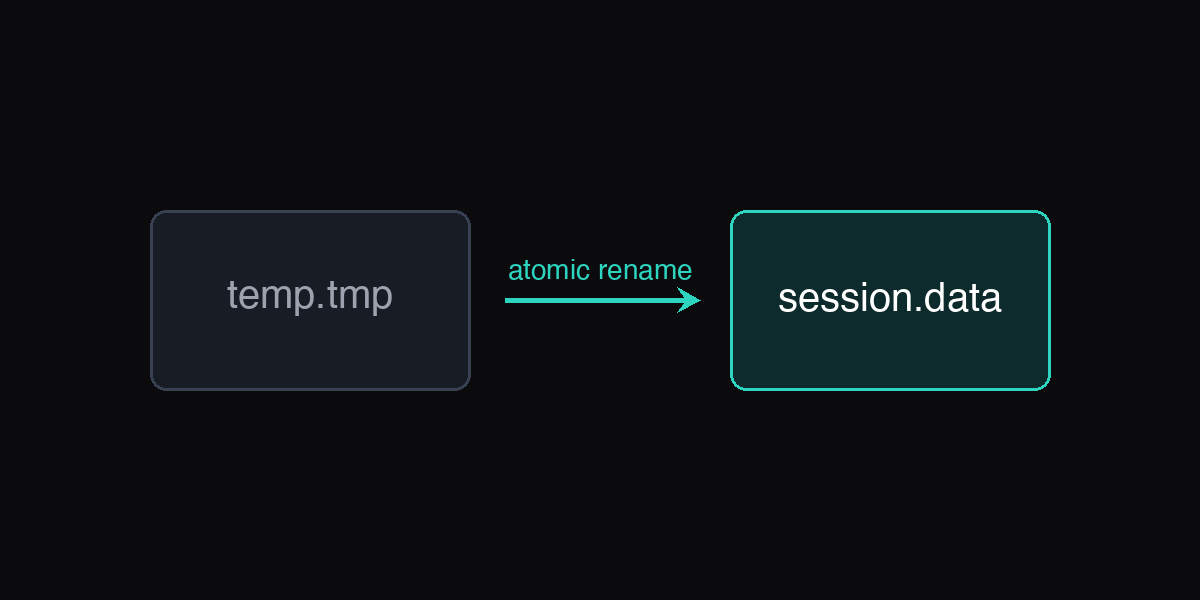
Atomic Session Saves and Crash Recovery. The invariant that makes session persistence safe — the invariant Ferryx’s workspace snapshots follow — is that a save must be all-or-nothing — write the new state to a temporary file, fsync it, then atomically rename() it over the live file — because rename within a filesystem is the one operation a crash cannot tear in half. Around that core sit three supporting layers: checksums (detect corruption that survived, from bit rot to partial disk conditions), backup rotation (keep N previous known-good states so recovery has somewhere to roll back to), and a non-fatal startup path (a corrupt file degrades to the last good backup — or a fresh state — never a launch loop). Together they turn “app crashed during save” from data loss into a non-event.
Why torn writes corrupt state
A non-atomic save looks like: open the live file, truncate it, write the new bytes, close. Every step is individually correct and the sequence is fatal — the window between truncate and close-last-byte is real time, and a crash (power loss, SIGKILL, kernel panic) in that window leaves a half-written file: valid JSON prefix, then nothing. The next startup parses it, hits EOF mid-object, and either errors out (you have lost your layout — the save meant to protect it destroyed it) or, with laxer parsing, loads a partially-filled structure whose missing fields default silently — corrupted state you discover later.
The subtlety is that most saves work fine — crashes during a multi-millisecond write are rare — which is exactly how torn writes survive code review for years. The bug’s frequency is proportional to crash rate × save rate, and a session manager saves on every significant change (pane open, layout move, session start): thousands of vulnerable windows per day of active use. Rare-per-window × high-window-count = eventually someone loses their workspace, usually during the one crash where the layout was the thing they needed to recover from it.
Three properties of session state make it worse than losing a document: it is the map (without it, sessions and worktrees still exist but you cannot find them), it is written at the worst time (save-on-change correlates with the churn a crash interrupts), and it is small enough to feel safe (a 4 KB config gets the copy-paste-in-emergency treatment; a multi-workspace tree does not). The fix is mechanical and cheap — the same pattern databases and package managers have used for decades: never let the live state and the in-progress write be the same bytes.
The atomic pattern in full: serialize state → write to state.json.tmp in the same directory (same filesystem is a hard requirement for rename) → fsync the file (push bytes to durable storage, not just page cache) → rename(state.json.tmp, state.json) (atomic swap — observers see old-or-new, never half) → optionally fsync the directory (makes the rename itself durable). The crash matrix is then trivial: crash before rename → old file intact; crash after rename → new file intact; never “half of each.”
Atomic write and checksum flow
Checksums address the failure mode atomicity cannot: corruption without a crash during save — disk errors, memory bit flips, a truncated backup restored by hand, an editor’s interrupted sync. The flow: each saved file carries a digest (CRC32 or SHA of its content, stored alongside or embedded); every load verifies before parsing — matching digest proceeds, mismatched digest triggers recovery instead of feeding garbage to the parser.
Two placement choices matter in practice: embed vs. sibling (an envelope { "checksum": …, "state": … } keeps the artifact self-contained — preferred when users might copy the file; a .sha256 sibling keeps the payload plain-JSON — preferred when external tools read it) and verify-before-parse ordering (checksum first means corruption fails loudly at a known boundary, not weirdly somewhere inside a half-understood structure — the difference between “state file corrupt, recovering from backup” and a confusing parser error three frames deep).
Checksums pair naturally with atomicity into one pipeline: write new state atomically, then verify on every read. Atomicity keeps crashes from producing corruption; checksums catch everything else and — critically — distinguish “corrupt” from “merely old,” which is the input the recovery path needs to choose correctly.
Recovery from backup rotation
Rotation answers the question corruption raises: recover from what? Keeping only the live file means a corrupt live file has no predecessor — so the save path maintains N previous good states (state.json.1, .2, .3, … or timestamped), rotating on each successful save, with the rule that rotation promotes only verified-good states (a save whose checksum passes becomes the new live file; the old live file demotes into rotation — never the reverse).
The recovery cascade at startup, in order:
- Live file loads and verifies → normal startup (the overwhelmingly common path).
- Live file corrupt (checksum/parse fail) → surface it visibly (log, UI notice: “recovered from backup — last save lost”) and load the newest rotation entry that verifies. Losing the last few minutes of layout churn is an acceptable trade against losing the workspace; silently loading an old backup without notice is not — the user deserves to know time was rolled back.
- All backups corrupt or absent → start with fresh state while preserving the corrupt file (
state.json.corrupt-<ts>) for forensics, and reconstruct the map from ground truth: the session registry and worktree directory are themselves enumerable — sessions relaunchable, trees listed from disk. This is the key architectural point: the layout file is a cache over reality, not reality itself — a design where disk state (managed worktrees, session records) can rebuild the map makes even total state loss a degraded restart instead of a catastrophe. - Corruption repeats across saves → escalate, don’t loop: repeated verify-failures after successful writes indicate environment problems (failing disk, memory errors, a sync client fighting the writes) and deserve a loud alert over another silent rotation cycle.
Rotation depth trades freshness against catastrophe coverage: three to five entries covers crash-during-save plus a bad-environment day without meaningful disk cost. The whole design — atomic envelope, checksums, rotation, ground-truth rebuild — is the machinery behind the formats the workspace snapshot post specifies, with the user-facing recovery walk-through in recovering a corrupted layout.
FAQ
Why not just write the file twice instead of using rename?
Rewriting the live file (even twice) still writes in place — each write opens the same inode and truncates it, so a crash mid-any-write still tears the live state; duplicating the bug doesn’t remove the window. The atomicity comes from rename specifically: within a filesystem it updates the directory entry in one indivisible step, so readers see the complete old file or the complete new file — in-place writes of any count never gain that property.
Does fsync actually matter, or is rename enough?
It matters on real hardware: without fsync on the temp file before rename, the renamed file’s bytes may still live only in page cache — a power loss after rename can leave the swap target existing but empty/short (the fsync-less variant of tearing). The full-safe order is fsync(file) → rename → fsync(dir); skipping the first risks empty-after-crash, skipping the second risks the rename itself not surviving. On modern journaled filesystems the residual risk shrinks but does not vanish — for state whose loss is costly, the complete sequence is cheap insurance.
How big should the backup rotation be?
Three to five entries covers the realistic threats: crash-during-save (one bad generation), a corrupted batch from a bad disk day (two or three), and still leaves headroom before rolling over the oldest good state — at typical session-save sizes this is kilobytes of disk. Depth beyond ~10 rarely helps (if ten consecutive generations are suspect, the problem is environmental and step 4’s escalation is the right response); depth of one is the fragile configuration — it protects against exactly one bad save.
Can I rebuild my workspace if every state file is gone?
Yes, if the design keeps ground truth in enumerable places — and that redundancy is the real safety net: managed worktrees list from disk (git worktree list / the managed root), session definitions from the session registry, layouts re-derivable from workspace templates. The state file accelerates restore; it is not the sole source of truth. Walkthrough of the rebuild path (including preserving corrupt files for diagnosis) is in recovering a corrupted layout.