
Leader and Worker Patterns for Coding Agents
Leader and Worker Patterns for Coding Agents. The leader-worker pattern assigns one agent (the leader) to decompose a task and supervise, while worker agents execute the resulting subtasks in parallel — each in its own worktree — with communication flowing through a shared source of truth (files in the repo: a plan, task files, result notes) rather than direct chat — a shape that assumes the workspace (such as Ferryx’s managed worktrees) has already given every worker an isolated tree. It scales coding agents without message-queue infrastructure precisely because the filesystem is the queue: plain text artifacts any agent can read and write, versioned by git, debuggable with cat.
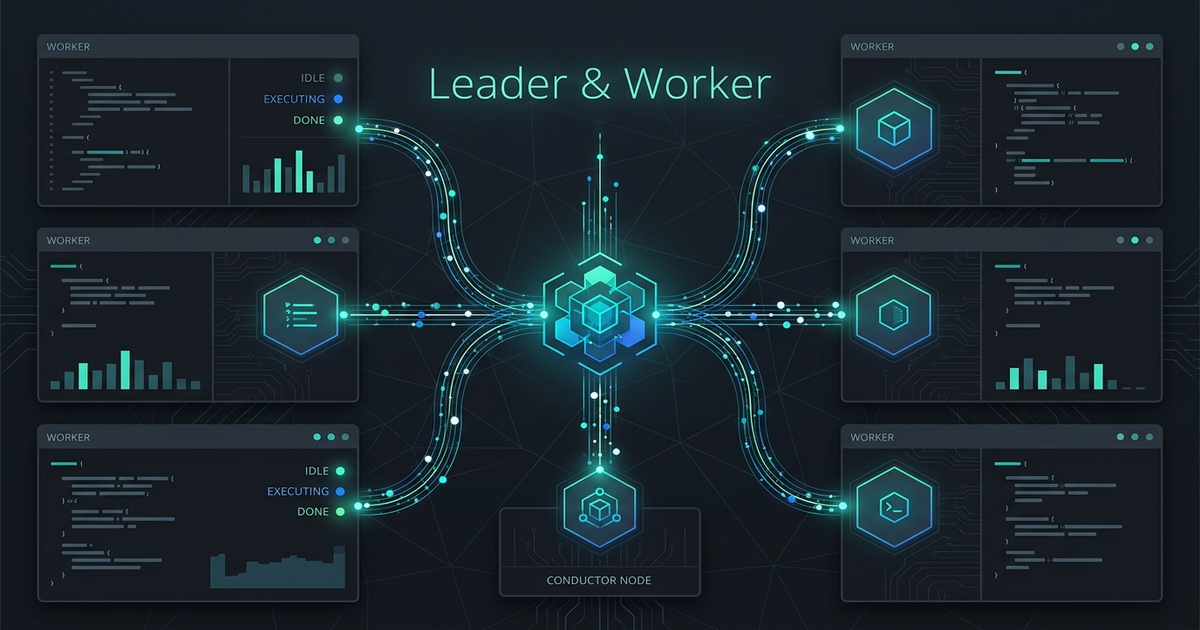
Roles of leader and workers
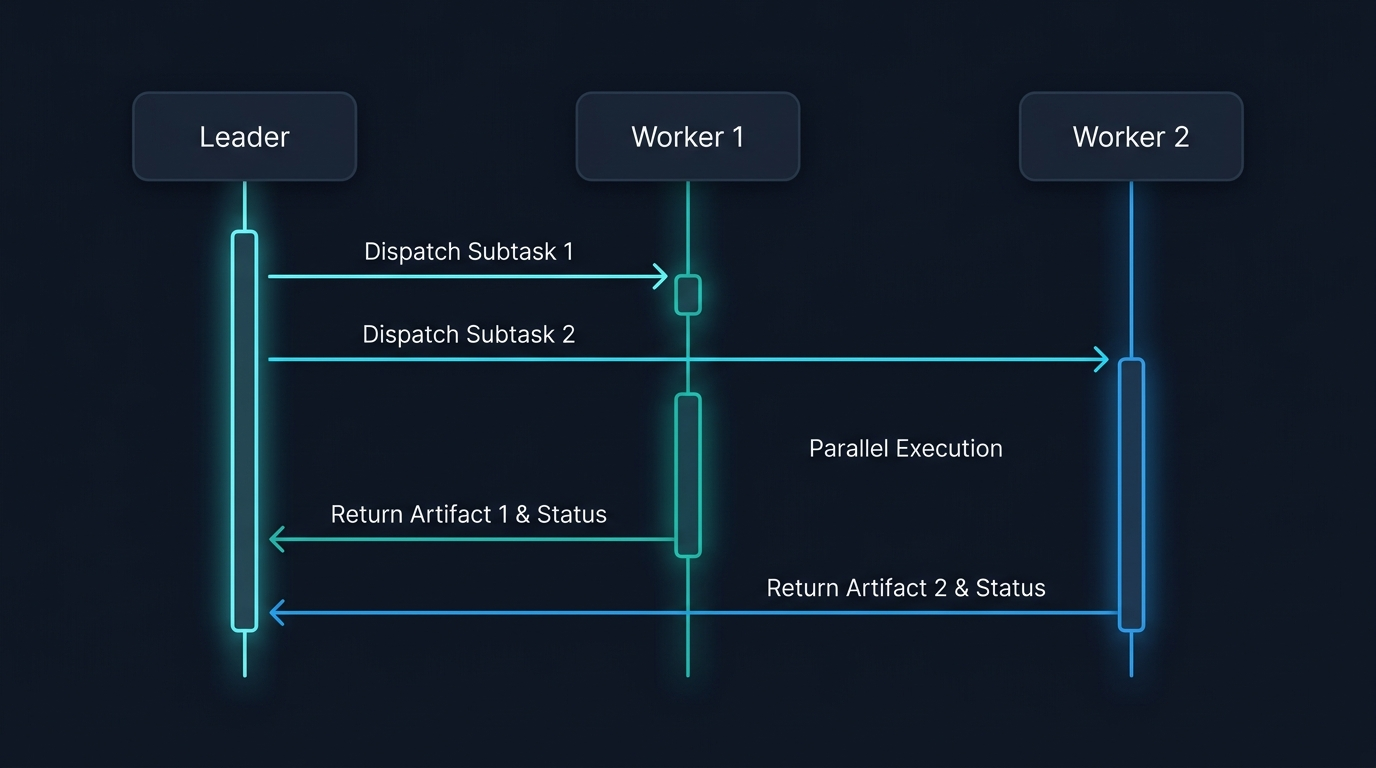
The leader plans, dispatches, and integrates — it does not execute subtasks itself. Its inputs are the goal and the repo; its output is a decomposed plan: an ordered list of subtasks, each with scope (“touch only billing/”), acceptance conditions (“tests X pass”), and dependency edges (“after task 2”). While workers run, the leader monitors state files, answers escalations, and — at the end — owns integration: reviewing worker results, resolving the merge sequence, and declaring the goal met. The discipline that makes this work is the leader resisting execution: the moment a leader “just quickly fixes” a worker’s output itself, the architecture degrades into an untracked side branch of work with no record of who did what.
Workers are narrow and deep: one subtask, one worktree, one definition of done. Each receives its task file — scope, acceptance, constraints — and works until its result note says done or blocked. Narrowness is load-bearing: a worker that finishes with a diff plus a structured note (“changed X, verified Y, uncertain about Z”) hands the leader something reviewable; a worker that returns raw diff forces the leader to reconstruct intent by re-reading the whole change. Blocked is a first-class outcome: a worker hitting an ambiguity writes the question and parks, rather than guessing — guessing across three workers is how parallelism manufactures contradictory code.
The asymmetry in context matters too: the leader needs breadth (the goal, the plan, all workers’ status), each worker needs depth (its task, its tree). This inverts typical “one big shared conversation” agent usage — broad context centralized in one supervised place, narrow context fanned out — and it is why the pattern maps cleanly onto workspace structures where sessions are separate objects with their own trees rather than one interleaved stream.
Handoff contract that works
Direct agent-to-agent chat is the anti-pattern: unstructured, unversioned, and lost on crash. The contract that replaces it is file-based, with five artifacts:
plan.md(leader → workers). The decomposition: task IDs, scopes, dependencies, acceptance. Written once before dispatch, edited only by the leader — workers read it; a plan drifting mid-flight under multiple writers is how scopes silently overlap.tasks/<id>.md(leader → one worker). The dispatch: everything that worker needs to start without asking — goal, file scope, acceptance check, allowed-to-touch list, and the explicit boundary (“do not modify shared config; escalate instead”).results/<id>.md(worker → leader). The return: summary of change, how acceptance was verified (commands + outcomes), open questions, and blast-radius notes (“touchedschema.sql, needs migration review”). A worker that cannot fill this in has not finished — the template is the definition of done.- Status transitions in a single register (
status.yml:queued → running → done|blocked, with timestamps). One file, one writer per row (each worker owns its row), readable by anyone — this is the leader’s dashboard and the operator’s dashboard simultaneously. - Escalation protocol in both directions. Workers signal
blocked+ question in their result file; the leader answers by editing the task file (append-only Q&A section), not by side channel — so the answer survives crash, context compaction, and handoff to a different operator.
Git gives the contract free durability: commit task dispatches and results as they happen, and the entire run reconstructs from history. The spec-driven loop covers the same file-based discipline for single-agent iteration; leader-worker extends it across many.
Failure and retry handling
Parallel workers fail in characteristic ways; the pattern pre-defines responses:
- Worker dies mid-task (crash, context exhaustion): status goes stale, leader notices via heartbeat/age, re-dispatches the task file to a fresh worker in a fresh worktree — the dead tree stays for autopsy, the new run starts clean. Idempotence lives in the acceptance criteria: “tests pass” is re-achievable; “apply 14 manual steps” is not, so task files forbid unrecorded manual state.
- Worker returns garbage (diff fails acceptance): the result file says
done, the acceptance check says otherwise — leader re-dispatches with the failure output appended to the task file. Second attempts that incorporate the first attempt’s error message converge far faster than blind retries; a third failure escalates to leader-decomposed-smaller (the task was mis-scoped, not mis-executed). - Two workers conflict (overlapping scopes discovered at merge): scopes were wrong in
plan.md— leader re-partitions, and the loser’s work is rebased or discarded by policy stated upfront (merge order is plan order; later workers re-read earlier results before integrating). Stating the policy before dispatch prevents workers from “defensively” hedging into each other’s territory. - The goal itself shifts mid-run: leader freezes dispatch, updates
plan.mdwith a changelog entry, and re-derives task files for unstarted work; running workers finish or are explicitly cancelled with reason. Silent plan drift — workers executing yesterday’s goal — is the failure this freeze exists to prevent.
Escalation to a human follows the same channel: blocked entries in the register, oldest first, are the operator’s queue — which is also the shape the attention inbox argument says status should present. Underneath all of it sits the isolation floor (one worktree per worker, ports and DBs fenced per tree — see port partitioning and database isolation), and the parallel agents use case documents the workspace mechanics these roles run on.
FAQ
Is this just multi-agent orchestration with extra steps?
It is multi-agent orchestration with the specific simplification that no message broker exists: files and git replace queues and topics. Compared to heavier frameworks, you trade delivery guarantees (no ack protocol — you poll status files) for total inspectability: every handoff is a diff you can read. For coding tasks — where artifacts are files anyway — the trade tends to favor the file-based version until you need hundreds of workers.
How big should a worker subtask be?
Small enough that one worker can reach “verified done” within a single focused session, large enough that the handoff overhead (task file + result file) is proportionally cheap — in practice, a coherent unit with a runnable acceptance check (a module, a test suite, a migration), not a single function and not a whole feature. When a task’s result file needs three paragraphs of “partially done,” the plan was wrong to make it one task.
What model or tool should leaders versus workers use?
Match capability to role shape: the leader needs broad reasoning over plan/integration decisions (often the strongest available model or a human-authored plan), workers need reliable execution within tight scope (often cheaper/faster — the model-lock pattern of routing worker nodes through one configured category and keeping orchestration elsewhere). The architecture does not depend on the choice; the separation of planning context from execution context is what keeps either choice tractable.
Can one human supervise leader-worker runs directly?
That is the design intent: the human reads one register (statuses, blocked questions, oldest-first) instead of N raw streams, intervenes at decision points the leader escalates, and reviews integration rather than every intermediate diff. Supervision cost becomes the leader’s escalation quality — which is why the handoff contract’s Q&A channel matters: sloppy escalations drag the human back into micromanagement the pattern was built to remove.